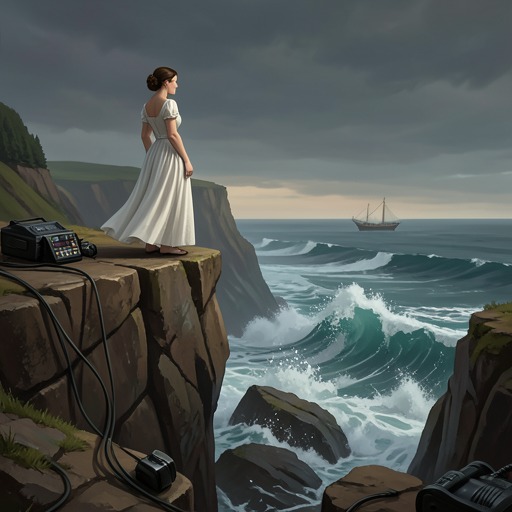
Irene's aborted suicide attempt at the Mulinelli
The HummingbirdIrene's aborted suicide attempt at the Mulinelli is a pivotal scene of danger and recognition in the Carrera family’s history. In August 1974, Marco alone understands that Irene’s stated errand to secure the family’s Vaurien sailboat may conceal an intention to drown herself. He follows her to the shore, where she does not enter the water; instead, she ties the boat safely and returns home with him. The scene joins the immediate fact of survival to a wider pattern of depression, isolation, and warning signs that the family does not recognize.
Background and warning signs
Irene has lived through recurring shifts in mood: scenes and rebellions, long silences, apparent renewals, bursts of affection and optimism, and returns to sadness and anger. By the summer of 1974, her family has become accustomed to these fluctuations, a familiarity that has dulled its response. She is seeing a psychoanalyst in Florence, but he is away for August. Although he has left a number she could call, the unfamiliar international prefix makes reaching him harder.
The summer’s plans have fallen apart one by one. A trip to Greece with friends is cancelled; a possible replacement trip to Ireland never takes shape; and suggestions that she spend time in Versilia go nowhere. Irene remains at the family’s summer house in Bolgheri, where she feels trapped by the same limited social world that, in the narrative’s account, is both a consequence and a cause of her depression. Her parents also continue to discuss Marco’s impending treatment for hormonal deficiency, a subject that Irene has overheard despite a family truce against arguing about it.
The danger is also legible in the material details of Irene’s behavior. She is described as visibly exhausted, with a strained appearance and a distant gaze, and she repeatedly listens to Lydia Lunch’s version of “Gloomy Sunday” on a red Walkman. The recording is a song associated with a legend of suicide, and Irene has kept it playing in a loop for days. These signs do not explain her crisis by themselves; rather, they sharpen the contrast between what is available to be noticed and what the people around her actually notice.
The walk to the Mulinelli
One evening, after a meagre dinner of leftovers, Irene says she is going to the beach to tie the Vaurien to its shed because a storm is expected. The errand sounds ordinary, but Marco immediately understands it as a pretext for going to the Mulinelli, a treacherous stretch of water in front of the family’s hut. Four people have drowned there, and the family has heard that each death was a suicide.
The rest of the household does not stop Irene. Her father accepts her explanation; her mother is occupied with the dishes, and Giacomo is drying them. Marco, nearly fifteen but still looking twelve because of his hormonal deficiency, is the one who follows. He slips out after her without calling for help, recognizing that no one else has grasped the danger and that he cannot leave her alone.
Irene tells Marco to go home, first without turning and then more forcefully. He continues after her. Their confrontation makes the threat plain without settling what Irene will do: she tries to drive him away, while he remains close enough to intervene if she approaches the water. At the beach, with the Mulinelli ahead of them, Marco watches as Irene turns instead to the boat. She secures a rope to a tree and around her hips, then hauls the Vaurien toward the shed. Marco does not take over or assist; he stays present while she finishes the task and ties the boat off.
Return and immediate consequence
Once the boat is safe, Irene unties the rope from her hips. The frightening expression Marco had seen during their confrontation is gone. The episode ends not with a spoken explanation or a declared change in Irene’s condition, but with the siblings walking back together. Their usual physical arrangement is reversed: Marco wraps an arm around her waist, while Irene puts hers around his shoulders. She occasionally brushes the back of his neck with her thumb.
That return matters, but it does not establish that Irene has recovered or that the underlying crisis has passed. The account gives the pair a brief interval of closeness after a moment in which Marco believed he might have to keep his sister from the water. It makes the outcome specific and limited: Irene does not drown that night, and the siblings go home together.
Family silence and narrative significance
The scene is set against a wider failure of attention. In a nearby thread of the narrative, Irene’s exhaustion and repeated “Gloomy Sunday” listening are visible to those around her, yet nobody responds to them as an alarm. Her mother, Letizia, is absorbed in her own dissatisfaction and does not recognize Irene’s state. At the same time, family members are occupied by separate concerns: Marco is focused on meeting Luisa, and Giacomo is preoccupied with his own suspicions and plans. The juxtaposition makes the family’s distraction part of the account of risk without turning any one missed cue into a sufficient explanation.
The novel also places Irene’s departure from the house beside her father’s reflection on a different kind of near-violence: Probus imagines that, for a fraction of a second, he may have wanted to shoot Aldino Mansutti during an earlier outburst. These adjacent episodes do not make the events equivalent. Instead, they frame the Mulinelli crisis within the book’s recurring attention to how an unspoken impulse, a coincidence, or a signal can become consequential—and how difficult it is for others to know what has passed through someone else’s mind.
The episode’s center is therefore not a triumph over depression but Marco’s act of noticing and staying. Irene is not reduced to the song or to the danger of the sea; her actions remain uncertain until she turns to the boat, completes the task, and walks back beside her brother. Their reversed embrace gives the scene its quiet conclusion: for once, the younger brother steadies the older sister, and neither has to make the return alone.